Friday, April 6, 2012

Good Friday

Jesus Christ was crucified, died, and was buried on the Friday which preceded the original Easter. Why is a day that marks Jesus’ horrible suffering and death on a cross called "good?"

Actually, the term 'good' is unique to the English language. According to Ken Collins, in Germany this day is called Karfreitag. “The Kar part is an obsolete word, the ancestor of the English word ‘care’ in the sense of cares and woes, and it meant mourning. So in German, it is Mourning Friday. And that is what the disciples did on that day—they mourned. They thought all was lost.”

The origin of the name Good Friday, according to some scholars, comes from an Old English synonym (good) for "holy." Others argue it is a corruption of the word "God," in the same way that "Good Bye" comes from the phrase "God be with ye."

Christians call this day “good” because Easter represents the culmination and the victory of Jesus’ “Good News,” or Gospel. Christ’s death is the fulfillment of God’s judgment on sin. Oswald Chambers puts it beautifully: “There is nothing in time or eternity more absolutely certain and irrefutable than what Jesus Christ accomplished on the Cross— He made it possible for the entire human race to be brought back into a right-standing relationship with God.” That is GOOD NEWS for us all!

Have you also wondered about the three days and three nights? There aren’t three days and three nights between Friday and Easter Sunday, so how is this explained? The scriptural reasoning is that the saying is idiomatic. It occurs elsewhere in scripture. Ken Collins notes that Jonah spent three days and three nights in the belly of the whale. But he was swallowed by the fish one day and spit out on the third day (Jonah 1:17—2:10). In order for there to be three days there could only be two nights separating them. Similarly, in Esther 4:16—5:1, there is a fast for ‘three days and three nights’ that begins on the first day and ends on the third day, which means only two nights were involved.

Jesus was buried on Friday, the day of his death, and rose three days later from the dead, breaking forever the bondage of sin over mankind. Chambers says “The heart of salvation is the Cross of Christ. The reason salvation is so easy to obtain is that it cost God so much. The Cross was the place where God and sinful man merged with a tremendous collision and where the way to life was opened. But all the cost and pain of the collision was absorbed by the heart of God.”

Good News and Happy Easter

Friday, March 30, 2012

Your Future Called and it Could Use Your Attention

You have brains in your head and feet in your shoes
You can steer yourself any direction you choose.
You’re on your own and you know what you know
And you are the one who’ll decide where to go.
 

Dr. Seuss

Anyone who can grasp the concept of a future understands the power of goal-setting and planning. We and no one else are responsible for our own lives, yet we spend so little if any of our time directing our lives, with or for any great purpose.

According to the Bureau of Labor Statistics how we spend our time might well surprise you. In a 24-hour day, sleep and personal care occupy the greatest chunk at 9.5 hours or 40%. We spend another 1.25 hours eating and drinking and 2 hours cleaning up from it; along with the laundry and the lawn, etc. And don’t forget our work. The average American spends 3.5 hours of his/her day at work (7.8 hours per day for those actually working). We spend 45 minutes shopping and 15 minutes in spiritual activities (for some they are the same). And here’s the topper – we spend a whopping (drum roll) 5.2 hours per day entertaining ourselves that’s more than a third of our waking day spent enjoying ourselves in the moment.

Mark Twain encourages us to "plan for the future because that is where [we are] going to spend the rest of [our] life.” But that is not what we do. In fact, very few of us set goals and plan (beyond business or job requirements) and fewer still write them down and review them regularly. Many web posts claim only 3% in the latter category, but I have not found sufficient study evidence to provide a number. Let’s just say it’s a very small percent of the population.

So, if almost anyone would agree that planning is beneficial, why do so few of us do it?
  
We are too busy

The Labor survey demonstrates that we are just too busy living in the moment to look down the road any great distance. For many of us the future is not much more than our next text response or what’s for lunch. If things are good now, why take time to think about possibly working harder on some goal to make them even better? After all, John Lennon implored us to live in the moment; “Life is what happens when you’re busy making other plans.”
 
Another way to put it is that too many of us are simply not serious about our future. We don’t live as though we had any greater purpose or significance than simply moving to the next thing. Yet with each passing day, we know in our hearts that unless we get serious, we will not accomplish anything of consequence. Who starts to build and does not count the cost? Clearly what is lost for most of us is a healthy balance between living well today and planning for a better tomorrow.

We Don’t Believe
 
Our own doubts can be powerful disincentives to goal-setting. We’ve carried many of them from our upbringing, childhood to present, we own them. They are so familiar to us they have become a part of us. And if you can’t squash your dreams yourself, tell them to someone who doesn’t value planning or goal-setting and they’ll help you kill them.

Remember Orville and Wilber the bicycle shop owners? They had a dream to change the world by figuring out this flying thing. How many times do you think they heard how ridiculous their dream was from family, friends, customers, and strangers alike? Through it all they were able to shake off their self-doubts and those of virtually everyone around them to accomplish something far greater than their immediate reach, financially, physically, or emotionally. Visit the Smithsonian sometime to see and read their plans. What a fabulous story of planning at its finest. As Dale Carnegie put it, “most of the important things in the world have been accomplished by people who have kept on trying when there seemed to be no hope at all.”

We Fear Failure

Perhaps the greatest obstacle to success in life is the fear of failure. It can paralyze and lock us into routines that are well below our potential. We focus only on the obstacles, the potential failure. Hannah Moore said that “obstacles are those frightful things when you take your eyes off your goals.”

People who fear failure don’t understand that it is a vital and necessary part of success, in fact a prerequisite. Anyone striving to reach his potential must be willing to risk repeated and often costly failures along the way.

Consider the Wright brothers once again. Not long ago I was able to see an extraordinary exhibit of their accomplishments in a large exhibit devoted to them at the Smithsonian. I was absolutely fascinated by their detailed notes and plans. They read like a story of heroic design against an unknown, uncharted abyss we call the atmosphere. It was standard operating procedure for them to take multiple sets of replacement parts to repair their machine crash after crash. But progress was made with each grinding and dusty crackup. Their notes read like ‘failure, failure, re-design, failure, tweak, slight improvement – failure and so on.’ Then on December 17, 1903 all their plans, failures, blood, sweat, and tears culminated in man’s very first controlled, powered and sustained, heavier-than-air human flight.

As far as your financial planning goes with us, our Monte Carlo model ‘lives’ the failures so you don’t have to experience them. We can confidently avoid them leaving nothing to fear, on the financial front anyway.

We Don’t Understand the Importance

Many people, in fact most, grow up with no introduction to the importance of goal-setting or planning. And unless they were introduced along the way, they remain unaware of the true potential. For these folks, stories about the heroes of goal-setting and achievement could well be about people from another planet. They would have no frame of reference even of the concept of planning for a better future.

How Can We Improve? And How Can Beacon Help?

Heidi Grant Halvorson, a Ph.D., motivational psychologist and author of the Harvard Business Review Single Nine Things Successful People Do Differently, addresses the reasons we are successful in reaching some of our goals and not others. She says that even brilliant and highly accomplished people are not good at understanding shy they succeed or fail at goal-setting. Its really quite more than native talent.

Here are Halvorson’s nine things successful people do differently (in quotes) with my thoughts added (in itallics) where we can help.

1. “Get specific. When you set a goal, try to be as specific as possible. Knowing exactly what you want to achieve keeps you motivated until you get there. Also, think about the specific actions that need to be taken to reach your goal.” Every financial goal you value is front-and-center in and fully integrated into our planning and management process.

2. “Seize the moment to act on your goals. Given busy schedules and multiple goals we routinely miss opportunities to act on a goal because we simply fail to notice them. Decide when and where you will take each action you want to take, in advance. Studies show that this kind of planning will help your brain to detect and seize the opportunity when it arises, increasing your chances of success by roughly 300%.” This is the strength of our process. We alert you the opportunities present themselves to improve a goal or goals and to make necessary adjustments if confidence slips.

3. “Know exactly how far you have left to go. Check your progress frequently — weekly, or even daily, depending on the goal.” Through Wealthcare we monitor your progress continually. You make adjustments when we talk or meet. Your plan is only as good as you make it.

4. “Be a realistic optimist. When you are setting a goal, by all means engage in lots of positive thinking about how likely you are to achieve it. Believing in your ability to succeed is enormously helpful for creating and sustaining your motivation. But whatever you do, don't underestimate how difficult it will be to reach your goal. Most goals worth achieving require time, planning, effort, and persistence.” Measuring difficulty or uncertainty is the key benefit of our continuing Monte Carlo stress testing. We rigorously ‘live’ your life plan through all kinds of realities including the wildly good and the horrendously horrible.

5. “Focus on getting better, rather than being good. Believing you have the ability to reach your goals is important, but so is believing you can get the ability. Many of us believe that our intelligence, our personality, and our physical aptitudes are fixed — that no matter what we do, we won't improve. As a result, we focus on goals that are all about proving ourselves, rather than developing and acquiring new skills.” Every time we meet your plan improves.

6. “Have grit. Grit is a willingness to commit to long-term goals, and to persist in the face of difficulty. Studies show that gritty people obtain more education in their lifetime, and earn higher college GPAs. Grit predicts which cadets will stick out their first grueling year at West Point.” You have grit and we do too. Together, we’ll make your plan and your life even better.

7. “Build your willpower muscle. Your self-control "muscle" is just like the other muscles in your body — when it doesn't get much exercise, it becomes weaker over time. But when you give it regular workouts by putting it to good use, it will grow stronger and stronger, and better able to help you successfully reach your goals.”

8. Don't tempt fate. No matter how strong your willpower muscle becomes, it's important to always respect the fact that it is limited, and if you overtax it you will temporarily run out of steam. Successful people know not to make reaching a goal harder than it already is. We have decades of experience working with clients through all kinds of markets. If your willpower muscle becomes overtaxed, lean on us.

9. Focus on what you will do, not what you won't do. If you want to change your ways, ask yourself, What will I do instead? We will help you confidently improve your life.

That's it for now. Hope you have a great weekend and consider "Following your dreams, they know the way."

Friday, March 23, 2012

Confessions of an Active Manager

As I look back to the early years of my career as a financial advisor, I recall being driven by three powerful and distinct motivating forces. The first was was necessity. With a wife and three children completely dependent on my commissions, success was not a dream or a goal, it was a necessity. But it was alright, I was also strongly motivated by youthful idealism. Success would come because I was devoted to doing a great job for my clients.

The third powerful motivator was a competitive nature. In fact all the brokers I knew seemed to posess similar characteristics. Our employers understood our motivations very well and were quite intentional about the kind of people they hired. They were expert at using these motivators to great advantage, both for themselves and for us.

The numbers game of sending out so many mailers, followed by so many telephone calls, followed by so many in-person meetings led to so many new clients. It became monotonous at times, but I remained motivated out of need, idealism, and competition. The last, competition was almost constantly fed, by an uninterrupted stream of sales contests.

There were contests for selling limited partnerships of oil & gas, real estate development and apartments and investment tax credits. There were even low income apartment deals designed specifically to lose money for our wealthy clients’ tax write-offs. The top tax bracket was 70% then. There were mutual fund wholesalers in our offices constantly and each one had an incredible promotional incentive trip to some exotic locale. One had to wonder how the company could afford such extravagance and still make any money for the target of their funds (were we the target or were our clients the target?).

After a brief stint with the partnerships and funds, I gravitated toward individual securities (particularly stocks) and managed money (particularly growth). I moved most of my clients into my firm’s portfolio management platform which worked pretty well for a while, but I quickly found myself apologizing or explaining moves that I would not have made myself. I became convinced I could do a better job for my clients. What’s more there would be no one with which to share the credit or the blame. That thought had a strong appeal to my competitive nature.

Inspired by great managers of the time like Warren Buffett, Peter Lynch, and John Neff, I read extensively and trained myself and then received formal training at my subsequent firm, Wheat First Securities. My foray into full-time discretionary management coincided with the early days of the Information Age. As an early technology adopter of PCs and the requisite software to make my job easier, I was strongly convinced of the powerful wave that was to sweep our economy, well in advance of the average investor, or money manager for that matter. I had an advantage that Peter Lynch called buying what you understand. Peter believed that individual investors had inherent advantages over large institutions because the large firms would not or could not invest in smaller companies because the value of the company was too small to make a meaningful impact on their assets, or because they were not yet on analysts’ and fund buyers’ radar. As an early adopter of technology, it became my investing expertise.

As the Information Age rolled along, I became fascinated with the growing wave of “disruptive destruction” where older technologies were being replaced by new ones. It seemed the cycles of destruction were becoming shorter and shorter at an exponential rate. Even the traditional rules of investing were being thrown out by many experts. The old value metrics seemed ill-suited to meet the light-speed requirements of the new “Information Age.”

As our returns and success compounded during the 90’s, our clients began to adjust their lifestyles in remarkable ways and we could not have been happier for them (or ourselves). Common were phone calls from ecstatic clients thanking us that they could put in a pool, re-decorate the house, buy a sailboat, or a Porsche - for cash!, or take that pan-European trip with the whole extended family. Some even took extended sabbaticals to spend their new-found treasure. Prospective clients were waiting in line to sign with us, enthusiastically recommended by our clients for our money-making abilities.

Our aggressive growth model attracted the most attention. From March 1990 through March 2000 the model generated a compound return of 26% per year for clients. Over those 52 quarters returns were as high as 59% in a quarter! For thirty five quarters or two thirds of the time, clients received positive return reports from us. And more than half of them were above the 30-year averages for stocks at the time which was 12%.

Of course there were some big losers too. The worst quarter saw a decline of 57% and seven quarters saw losses of greater than 10% (40% annualized). It was interesting how huge gains made people more accepting of huge losses, but the real tests would come.

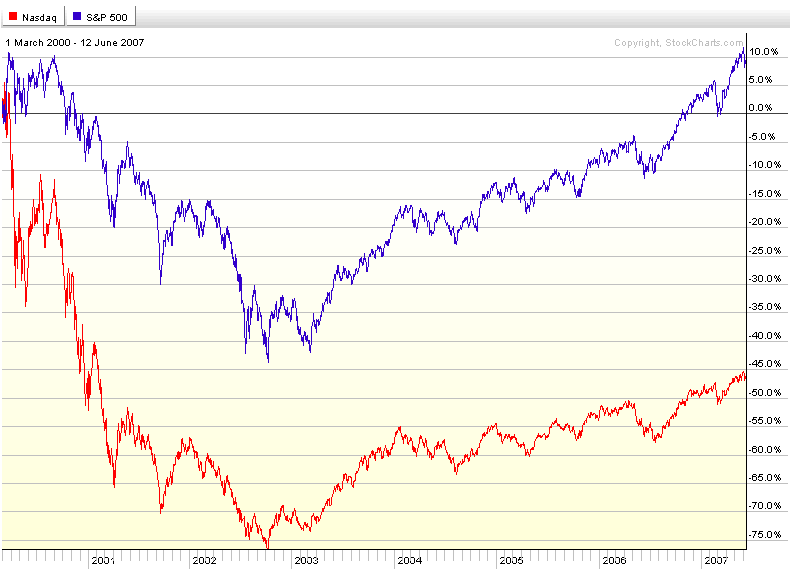
In March of 2000 the Internet Bubble exploded sending stocks tumbling. The NASDAQ, home of most technology stocks at the time fell 50% by the end of 2000. It would fall another 25% for a total of 76% to its bottom reached October of 2002. The S&P fell 43% before it bottomed the same time. Of course, in addition to the Internet crash, there were other ‘disruptions’ such as 911, war with Iraq, accounting scandals and Enron.  


Needless to say, these events coupled with huge mounting losses took their toll on our client base. The new clients, the ones we refer to in the industry as “hot money clients” (those who chase top returns) were the first to leave. Then some of our older clients began to leave convinced we would not recover their losses. While we added significant diversification, moving away from technology, our portfolios continued to decline with the markets. Growth stocks were dead and value stocks were in.

During this time Alan Greenspan, Chairman of the Federal Reserve took interest rates to record lows and began pumping money into the economy to replace the billions that had evaporated in the stock market. The next wave of funds leaving came when low rates began a bull market in real estate – and the next bubble began to inflate. My argument that stocks were cheap and would come back with far better returns than real estate carried little weight.

While my clients had done better than the benchmarks we used to measure their performance and they had more money than they would have had if they invested themselves, they were still leaving, unhappy. Even though I had accomplished my objectives of beating my benchmarks, I had somehow fallen short of meeting the expectations of my clients.

Soon after reaching this stark realization, I had a Damascus road experience. It came through three close friends. The first was a client who left saying she was unhappy, not so much with her performance, but that we never talked about what she wanted to do with her money.

The second (same day) came when a good friend, with whom I had started my career, showed me some software he was using. I was fascinated, particularly because it put the client squarely in the center of the process.

Later that same day I received a phone call from Dave Loeper, an old friend and mentor from my Wheat First days and founder of a company I had invested in when he and I had left Wheat six years earlier. His company was known as Financeware. Dave, was calling regarding a deadline to get signatures from his angel investors.

Dave would spend the next hour and a half (time he really didn’t have) converting me from a performance manager to a wealth manager. He asked me a couple of questions that still resonate with me today. “Sam, what value do you bring to your clients?” My answer continued to belie acceptance of his assertions when I said, “I deliver portfolio returns to my clients that are superior to those they can get on their own or with indexes.” He then asked “can you guarantee that?” When I responded that obviously I could not, he asked one more time: “What value do you provide to your clients?”

In that moment it became clear that my clients deserved better than a performance-driven value proposition that is truly no more than a hope for success. I spent the next several months learning as much as I could about Financeware’s program known as Wealthcare. We converted our entire business model from a portfolio focus to a client focus. Conversations with clients became incredibly authentic. It is not an exaggeration to say that I learned more about my clients in the first hour of an initial Wealthcare plan meeting than I had learned in the 5, 10, or 15 years of managing their assets.

Validation that we had made the right choice came quickly. Client plans revealed significant opportunities that had been ignored by our portfolio/return-centric approach. We realized dramatic improvement in the goals our clients valued without sacrificing their current lifestyles. It became clear that the very methods I was using before to create opportunity for my clients was in fact creating uncertainty that hid or diminished them. For instance, in almost every case, we found that our clients were taking more risk than was required to meet or exceed their goals. As a result, our overall portfolio risk as a firm dropped substantially.


As you look at the graph above you can see there was a second drop of greater proportion in the S&P 500 index (in blue) and a much lower one in the NASDAQ (in red) in 2008 and 2009. Most of the nation’s banks and financial companies reside in the S&P 500. As they were hit the worst, the NASDAQ did comparatively better this time around.

So how did we do? We are focused on confidently meeting clients’ goals with sufficient wealth, not return, so graphics don’t tell the full story. Perhaps the greatest difference between 2000 and 2008 came in our telephone traffic. It pains me to think back to 2000 and the many panicked calls I fielded with little more than “stay the course, it will come back” for comfort.

In 2008/2009 our phones didn’t ring with the frenzied calls of 2000. Conversations were mostly prompted by us as we doubled and tripled our efforts to stay in touch through challenging times. When our clients asked how ‘we’ were doing, we offered them substantive information from their latest stress tests which showed they could be confident of meeting or exceeding their goals, despite market declines. It helped significantly that most had experienced significantly less volatility than the 37% declines of the S&P 500. In fact most (86%), required no changes to their plans as a result of the declines.

Today, with six years of Wealthcare experience for more than 75 families, I can happily say that our clients are empowered to live more abundant and purposeful lives as a result of our dramatic change in course. We and our clients no longer take life as it comes, we design lives with purpose.